Case Study Deep-Dive: How Slack, Zoom, and HubSpot Built Billion-Dollar Moats Through Customer Understanding
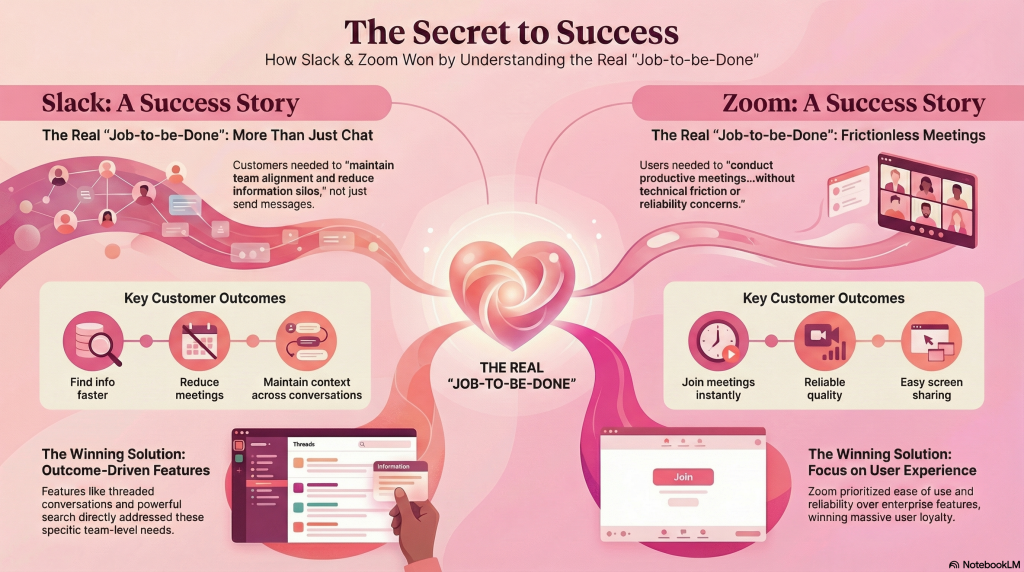
Three companies. Three different markets. One shared secret.
Slack didn’t build better chat. Zoom didn’t build superior video conferencing. HubSpot didn’t create more powerful marketing automation.
Yet all three built billion-dollar businesses that dominated their categories while established competitors – with more resources, better distribution, and superior technical capabilities – watched market share evaporate.
The secret wasn’t technological innovation. It was customer understanding.
While competitors focused on feature arms races, these companies built competitive advantages through deep insights into customer jobs, desired outcomes, and switching barriers. They discovered that sustainable differentiation comes not from what you build, but from what you understand about why customers need it built.
This analysis examines how Slack, Zoom, and HubSpot applied customer discovery principles to create competitive moats that transcended feature-based competition. The patterns that emerge provide a blueprint for building customer-driven competitive advantages in any market.
Slack's Transformation

When Stewart Butterfield and his team began developing Slack in 2012, the team communication market was already saturated. Email dominated workplace communication. Instant messaging platforms like Skype and HipChat served real-time needs. Enterprise collaboration tools like Microsoft SharePoint handled document sharing and project coordination.
Yet Slack achieved the fastest B2B software adoption in history, growing from zero to $4 billion valuation in four years. The achievement becomes more remarkable when considering the competitive landscape Slack entered.
Market Context and Competitive Landscape
The team communication market in 2012 appeared mature and well-served:
Email dominated with universal adoption, integration into all business systems, and deeply embedded organisational workflows. Most professionals spent 2-3 hours daily managing email communication.
Instant messaging platforms like Skype for Business, HipChat, and Jabber provided real-time communication capabilities with presence indicators, file sharing, and basic group conversations.
Enterprise collaboration tools like Microsoft SharePoint, Atlassian Confluence, and IBM Lotus Notes offered document management, project tracking, and structured collaboration features.
Project management platforms like Basecamp, Asana, and JIRA included communication features alongside task management and project coordination capabilities.
Any rational competitive analysis would have concluded that team communication was a solved problem with multiple adequate solutions and high switching costs due to organisational embedding and network effects.
Customer Discovery Insights and Job Redefinition
Slack’s breakthrough came from understanding that teams weren’t trying to “send messages to colleagues.” They were trying to “maintain team alignment and reduce information silos while minimising communication overhead.”
This job-level insight revealed fundamental problems with existing solutions:
Email created information silos. Important discussions remained trapped in individual inboxes, making it difficult for team members to access relevant context or contribute to ongoing conversations.
Context switching was expensive. Teams used multiple tools for different communication needs, creating cognitive overhead and reducing productivity as people switched between email, instant messaging, project management tools, and file sharing systems.
Information discoverability was poor. Critical decisions and discussions were scattered across various platforms, making it difficult to find relevant information when needed.
Asynchronous collaboration was limited. Existing tools were optimised for either real-time interaction (chat) or formal communication (email), with little support for the informal, ongoing conversations that drive team coordination.
Specific Moat Construction Mechanisms
Slack’s customer discovery insights guided specific product decisions that created competitive moats:
Channel-based organisation emerged from understanding that teams organize work around projects, topics, and functions rather than individual relationships. Unlike email threads or point-to-point messaging, channels created persistent spaces for ongoing collaboration around specific topics.
Threading and context preservation addressed the team outcome of maintaining conversation context. While competitors focused on real-time messaging, Slack designed features that preserved discussion history and enabled asynchronous participation in ongoing conversations.
Integration ecosystem development solved the context switching problem by bringing other tools into the communication layer rather than trying to replace them. This approach created network effects as each integration made Slack more valuable while increasing switching costs.
Search and discoverability features addressed information silos by making all team communication searchable and accessible. This capability transformed Slack from a messaging tool into a team knowledge base.
Results and Competitive Response
Slack’s customer-driven approach created competitive advantages that established players struggled to replicate:
Microsoft Teams launched with superior technical capabilities and distribution advantages through Office 365, but initially focused on feature parity rather than job understanding. Early versions felt like Skype with channels rather than a rethinking of team communication.
HipChat and other incumbents added channel features and integration capabilities, but their existing architectures and user expectations limited their ability to fully reimagine team communication around customer outcomes.
Email integration became necessary rather than optional as teams increasingly used Slack as their primary communication hub, creating switching costs that transcended the communication tool itself.
The sustainability of Slack’s competitive advantage is evidenced by its $27.7 billion acquisition by Salesforce in 2021, despite intense competition from Microsoft Teams and other well-funded alternatives.
Zoom's Disruption

Eric Yuan’s decision to leave WebEx and found Zoom in 2011 defied conventional business wisdom. WebEx dominated enterprise video conferencing with extensive feature sets, established customer relationships, and significant technical resources. Cisco’s backing provided distribution advantages and enterprise credibility that startups couldn’t match.
Yet Zoom achieved rapid market penetration and eventual dominance by recognising a fundamental misalignment between buyer and user needs in the video conferencing market.
Established Market Disruption Story
The video conferencing market in 2011 was characterised by:
Feature-rich enterprise solutions like Cisco WebEx, Microsoft Lync, and GoToMeeting that prioritised administrative control, security features, and enterprise integration over user experience.
High switching costs due to enterprise licensing agreements, IT department preferences, and integration with existing systems.
Complex deployment models that required IT involvement for setup, user management, and troubleshooting.
Price-based competition among established players offering similar feature sets to enterprise buyers.
Market research would have indicated limited opportunity for new entrants given the established player advantages and apparent customer satisfaction with existing solutions.
End-User vs. Buyer Insight Differentiation
Zoom’s customer discovery revealed a critical insight: IT departments and end users had fundamentally different jobs to be done when it came to video conferencing.
IT department job: “Manage enterprise communication infrastructure with security, control, and compliance”
End user job: “Conduct productive meetings with remote participants without technical friction or reliability concerns”
This insight revealed that existing solutions were optimized for the wrong job. While vendors competed on enterprise features that addressed IT concerns, they created poor experiences for the people actually using the software daily.
Zoom’s research identified specific end-user outcomes that existing solutions failed to deliver:
Meeting join simplicity: Users wanted to join meetings with a single click rather than navigating complex interfaces, downloading plugins, or entering multiple identifiers.
Audio/video reliability: Users needed consistent, high-quality audio and video that worked across different devices and network conditions without technical intervention.
Cross-platform compatibility: Users wanted seamless experiences across desktop, mobile, and web platforms without feature limitations or additional software requirements.
Intuitive interface design: Users needed controls that were immediately understandable without training or technical support.
Freemium Model for Viral Adoption and Network Effects
Zoom’s business model innovation complemented its product strategy by enabling viral adoption that bypassed traditional enterprise sales processes:
Bottom-up adoption allowed individual users and small teams to experience Zoom’s superior user experience before organizations made purchasing decisions.
Network effects emerged as users invited external participants to Zoom meetings, spreading adoption beyond organizational boundaries.
User advocacy developed as people experienced reliability and ease-of-use improvements, creating internal pressure for organizational adoption.
This viral growth model created competitive pressure on incumbent solutions as end users increasingly preferred Zoom experiences over enterprise-mandated alternatives.
Pandemic Stress Test of Competitive Advantages
The COVID-19 pandemic provided an unprecedented stress test of video conferencing solutions as usage increased by orders of magnitude across all platforms. Zoom’s customer-driven competitive advantages proved sustainable under extreme conditions:
Reliability under load demonstrated the technical foundation behind Zoom’s user experience focus, as the platform scaled more effectively than competitors during peak demand periods.
Ease of use at scale became critical as non-technical users across all demographics needed video conferencing capabilities without IT support.
Consumer market expansion validated Zoom’s user-centric approach as the platform successfully served consumer use cases that enterprise-focused competitors couldn’t address effectively.
Despite significant competitive responses from Microsoft, Google, and other tech giants, Zoom maintained market leadership and continued growth throughout the pandemic period.
HubSpot

Brian Halligan and Dharmesh Shah founded HubSpot in 2006 by recognizing that marketing professionals faced a fundamental transformation in how customers discovered and evaluated products. Rather than competing in the existing marketing automation category, they created an entirely new market around “inbound marketing.”
Category Creation Through Customer Understanding
HubSpot’s customer discovery revealed that marketing professionals had a higher-level job than “execute marketing campaigns.” They were trying to “attract, engage, and delight customers through valuable content and experiences.”
This job understanding revealed limitations in the existing marketing technology landscape:
Point solution fragmentation forced marketers to use separate tools for email marketing, web analytics, content management, lead generation, and customer relationship management, creating data silos and workflow inefficiencies.
Campaign-focused thinking optimised for individual marketing activities rather than complete customer lifecycle management, limiting the ability to create cohesive customer experiences.
Traditional interruption marketing was becoming less effective as customers gained more control over information consumption and developed resistance to traditional advertising approaches.
Integrated Platform Strategy Rationale
HubSpot’s platform approach emerged from understanding that marketing success required integration across multiple functions rather than excellence in individual capabilities:
Content creation and management needed integration with analytics and lead generation to enable data-driven content strategy and performance optimisation.
Lead generation activities required connection to nurturing workflows and sales processes to create seamless customer acquisition funnels.
Customer analytics needed to span the complete customer lifecycle from initial awareness through retention and expansion to enable comprehensive performance measurement.
Marketing and sales alignment demanded shared data and workflow integration to eliminate friction in the customer acquisition process.
This integrated approach created switching costs and network effects that point solutions couldn’t replicate, as customers became dependent on cross-functional workflows and data integration.
Content Marketing Methodology as Moat Reinforcement
HubSpot’s content marketing strategy served dual purposes of customer acquisition and competitive differentiation:
Educational content creation established thought leadership in inbound marketing methodology while demonstrating the effectiveness of the approach.
Methodology documentation created a framework that customers could implement with or without HubSpot software, building trust and demonstrating expertise.
Community building around inbound marketing principles created network effects and switching costs as customers invested in learning and implementing HubSpot’s methodologies.
Certification programs developed customer expertise in HubSpot’s approach while creating barriers to competitive solutions that required different methodologies.
This content strategy created what economist call “complementary assets” – resources that increased the value of HubSpot’s platform while being difficult for competitors to replicate.
Evolution and Market Expansion
HubSpot’s customer-driven approach enabled successful expansion beyond marketing automation into sales and service software:
Sales platform development extended the customer lifecycle focus beyond marketing to include complete revenue operations, addressing the job of “accelerate revenue growth through integrated customer acquisition and expansion.”
Service software creation completed the customer lifecycle platform by addressing post-sale customer success and retention outcomes.
Operations hub development provided data integration and workflow automation capabilities that supported the complete inbound methodology across all customer touchpoints.
This expansion demonstrated the sustainability of customer job-focused competitive advantages, as understanding of customer lifecycle outcomes enabled successful market expansion into adjacent categories.
Common Patterns
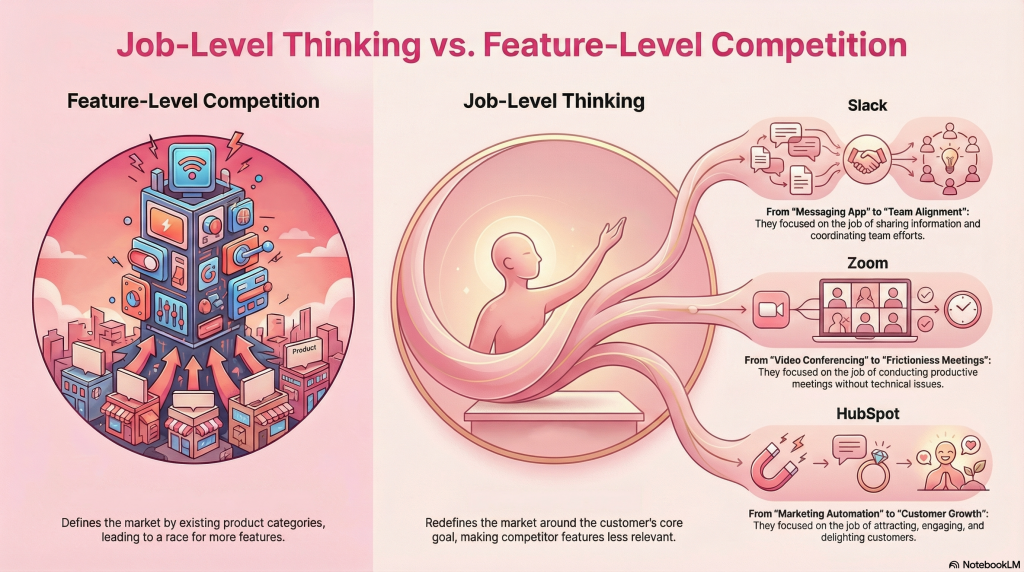
Analysis of Slack, Zoom, and HubSpot reveals four consistent patterns that enable customer discovery to create sustainable competitive advantages:
Job-Level Thinking vs. Feature-Level Competition
All three companies redefined their markets around customer jobs rather than competing on features within existing product categories:
- Slack: From “messaging” to “team alignment and information sharing”
- Zoom: From “video conferencing” to “productive meetings without friction”
- HubSpot: From “marketing automation” to “attract, engage, and delight customers”
This job-level focus enabled market redefinition that created new competitive landscapes where existing players’ advantages became less relevant.
End-User Outcome Focus Over Buyer Feature Lists
Each company prioritised end-user experience and outcomes over buyer decision criteria:
- Slack optimised for team productivity rather than IT management requirements
- Zoom prioritised user experience over enterprise feature checklists
- HubSpot focused on marketer effectiveness rather than traditional ROI metrics
This end-user focus created viral adoption and user advocacy that influenced organisational purchasing decisions from the bottom up.
Platform and Ecosystem Advantages
All three companies built platform capabilities that created network effects and switching costs:
- Slack’s integration ecosystem made the platform more valuable as teams added tools and workflows
- Zoom’s ease of use created network effects as users invited external participants to meetings
- HubSpot’s integrated platform created switching costs through data integration and workflow dependencies
These platform advantages compounded over time as adoption increased and customer investments deepened.
Continuous Customer Discovery Investment
Each company maintained focus on customer understanding even after achieving market success:
- Slack continued evolving based on team workflow insights rather than competitor features
- Zoom expanded platform capabilities based on user needs rather than enterprise feature demands
- HubSpot grew into adjacent markets through customer lifecycle understanding rather than product expansion
This ongoing investment in customer discovery enabled sustained competitive advantages and successful market expansion.
Lessons
The success patterns demonstrated by Slack, Zoom, and HubSpot provide actionable insights for SaaS companies seeking to build sustainable competitive advantages:
Implementation Patterns That Work Across Contexts
Start with job discovery rather than market analysis. Understanding what progress customers seek to make provides more valuable insights than analyzing competitor features or market size data.
Prioritise user outcomes over buyer requirements when they conflict. End-user satisfaction drives adoption and advocacy that influences purchasing decisions more effectively than buyer-focused features.
Build platform capabilities that create network effects and switching costs rather than point solutions that can be easily replicated or substituted.
Invest in ongoing customer discovery rather than treating customer research as a one-time project. Customer understanding provides cumulative competitive advantages that compound over time.
Warning Signs of Commoditisation Vulnerability
Feature-driven roadmaps that prioritise competitive parity over customer outcomes indicate reactive rather than strategic product development.
Buyer-focused optimisation that ignores end-user experience creates vulnerability to bottom-up disruption from user-centric alternatives.
Point solution thinking that optimises individual capabilities rather than integrated workflows limits competitive differentiation and creates substitution risk.
Limited customer discovery investment indicates reliance on internal assumptions rather than customer insight for strategic decision-making.
Framework Adaptation for Different Market Types
Enterprise markets require understanding both buyer and user jobs, with strategies that address organisational decision-making while optimising user experience.
SMB markets often have aligned buyer and user interests, enabling more direct focus on end-user outcomes and viral adoption strategies.
Consumer markets benefit from network effects and viral growth enabled by superior user experience and social sharing mechanisms.
Vertical markets require deep understanding of industry-specific jobs and outcomes that horizontal solutions may not address effectively.
The common thread across all market types is the importance of understanding customer jobs and desired outcomes rather than competing solely on features or traditional competitive factors.
The Customer Discovery Advantage
Slack, Zoom, and HubSpot demonstrate that sustainable competitive advantages in SaaS markets come from superior customer understanding rather than superior technology. While competitors focused on feature arms races, these companies built moats based on insights that were invisible to market incumbents.
The patterns are clear: job-level thinking beats feature-level competition, end-user outcomes drive organisational adoption, platform effects create sustainable advantages, and ongoing customer discovery enables continuous differentiation.
The methodology is proven: systematic customer discovery reveals opportunities that traditional market analysis misses, enabling market redefinition and competitive advantage creation that transcends feature-based competition.
The question for SaaS leaders is whether they’ll invest in customer discovery capabilities that create lasting competitive advantages, or continue fighting feature wars while others build uncopiable moats through superior customer understanding.
The choice will determine which companies build the next generation of billion-dollar SaaS businesses and which ones remain trapped in commoditisation cycles where features are copied and competitive advantages prove temporary.
In markets where technology capabilities are increasingly commoditised, the most sustainable competitive advantage may be the one that’s completely invisible to your competition: deep understanding of why customers really hire your product and how they measure success.