The Customer Discovery Framework: Integrating JTBD, Customer Development, and ODI

Stop asking customers what features they want.
If there’s one lesson from 15 years of building technology products, it’s this: feature requests are solutions, not problems. When customers tell you they want “better reporting,” they’re not describing their need – they’re prescribing their cure.
Henry Ford captured this insight perfectly: “If I had asked customers what they wanted, they would have said faster horses.” Customers think in terms of existing solutions, not underlying jobs to be done.
Yet most product teams still build roadmaps based on feature requests, competitive analysis, and internal assumptions. The result? Industry-average innovation success rates hover around 17%. Companies burn resources building products customers don’t value, features that don’t drive adoption, and solutions that miss the mark entirely.
But there’s a better way. Companies that employ systematic customer discovery methodologies achieve innovation success rates of 86% – five times the industry average. They don’t build better features; they build better understanding.
This article presents an integrated customer discovery framework that combines three proven methodologies: Jobs-to-be-Done theory, Customer Development, and Outcome-Driven Innovation. When applied together, these approaches create a comprehensive system for building competitive advantages through superior customer understanding.

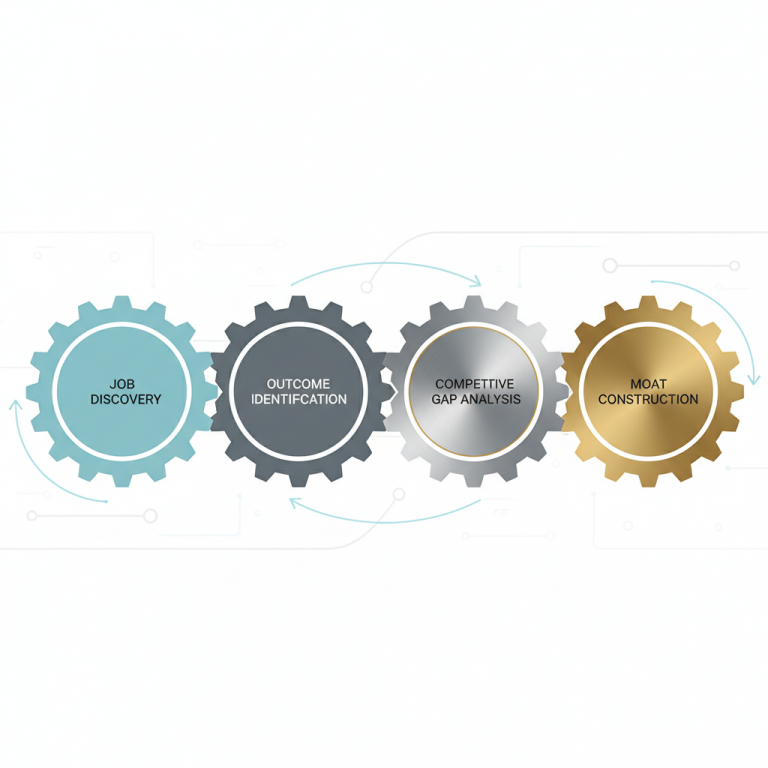
The Four-Phase Customer Discovery Framework
Traditional product development starts with ideas and seeks markets. Customer discovery starts with markets and develops ideas. This fundamental inversion – from solution-first to customer-first – transforms how organisations approach innovation and competitive strategy.
The integrated framework operates through four sequential phases that build upon each other:
- Job Discovery and Market Definition: Understanding the fundamental progress customers seek to make
- Outcome Identification and Prioritization: Quantifying how customers measure success
- Competitive Gap Analysis: Identifying opportunities competitors miss
- Moat Construction: Building sustainable advantages through superior outcome delivery
Each phase combines insights from multiple methodologies while addressing the limitations of any single approach. The result is a systematic process for translating customer understanding into competitive advantage.
Job Discovery and Market Definition
The foundation of customer-driven competitive strategy lies in understanding the core jobs that customers are trying to accomplish. This requires moving beyond product categories and feature lists to identify the fundamental progress customers seek to make in their lives.
Moving from Product Categories to Customer Jobs
Traditional market definitions center around product categories: “We’re in the project management software market” or “We compete in the video conferencing space.” (Click here my LinkedIn post of the topic) These product-centric definitions create blind spots that prevent organisations from identifying competitive threats and market opportunities.
Job-based market definitions focus on customer progress: “We help teams coordinate activities to deliver projects on time and within budget” or “We enable productive meetings without geographic constraints.” This subtle shift opens new perspectives on who your real competitors are and where growth opportunities exist.
Consider how Netflix redefined their market. Instead of competing in “DVD rental,” they recognised they were in the “entertainment at home” job. This insight enabled them to identify streaming as a superior solution for the same customer job, while traditional competitors remained trapped in physical media thinking.
The Forces of Progress Analysis
Understanding why customers hire and fire solutions requires analysing the forces that drive purchasing decisions. Bob Moesta’s Forces of Progress framework identifies four forces that influence every buying decision:
Push forces create dissatisfaction with the current situation. These are the struggles, frustrations, and limitations that make customers seek alternatives. Effective customer discovery identifies not just what customers struggle with, but the circumstances that make those struggles acute.
Pull forces attract customers to new solutions. These are the promised benefits, outcomes, or improvements that create desire for change. Understanding pull forces helps organisations position their solutions more effectively and design features that address genuine customer aspirations.
Anxiety forces create resistance to change. Even when customers recognise problems and see attractive alternatives, they hesitate to switch due to concerns about implementation, learning curves, cost, or organisational disruption. Customer discovery must uncover these anxieties to design solutions that minimise switching barriers.
Habit forces maintain the status quo. Customers often continue using suboptimal solutions simply because change requires effort and attention. Understanding habit forces helps organisations design onboarding and adoption strategies that overcome inertia.
Interview Methodologies for Job Discovery
Effective job discovery requires specific interview techniques that avoid leading questions and solution bias. The goal is understanding customer circumstances, not validating product ideas.
Switch interviews explore recent purchasing decisions to understand the forces that drove customers from one solution to another. These interviews reveal the push, pull, anxiety, and habit forces in action, providing insights into what triggers behaviour change.
Non-consumption interviews examine why some people who could use your product choose not to purchase anything. These conversations often reveal unmet jobs or unaddressed anxieties that represent market opportunities.
Struggle interviews focus on specific instances when customers struggled with the job you help them accomplish. Rather than asking about general preferences, these interviews explore particular moments of frustration or failure.
The key to effective job discovery interviews is focusing on circumstances rather than characteristics, and stories rather than opinions. Instead of asking “What features would you want in project management software?” ask “Tell me about the last time you struggled to coordinate a project. What was happening? What did you try? What worked? What didn’t?”
Outcome Identification and Prioritisation
Understanding customer jobs provides direction, but building competitive advantages requires specificity. Outcome-Driven Innovation methodology provides a systematic approach to identifying and quantifying the specific metrics customers use to measure success when executing their jobs.
Job Mapping and Outcome Statement Structure
Job mapping breaks down the core customer job into discrete steps and sub-jobs, creating a comprehensive view of the customer’s process. Each step represents a point where value can be created or destroyed, providing opportunities for innovation and differentiation.
For a project management job, the map might include steps like:
- Define project scope and requirements
- Identify necessary resources and capabilities
- Allocate tasks to team members
- Monitor progress and identify bottlenecks
- Adjust timelines and resource allocation
- Communicate status to stakeholders
- Document learnings and outcomes
Each step in the job map generates multiple desired outcomes that customers use to measure success. These outcomes follow a specific structure developed by Tony Ulwick: direction of improvement + performance metric + object of control + contextual clarifier.
Examples of well-structured outcome statements:
- “Minimise the time it takes to identify project bottlenecks when monitoring progress”
- “Increase the accuracy of resource allocation decisions when planning project timelines”
- “Reduce the effort required to communicate project status to stakeholders”
- “Minimise the risk of missing project deadlines due to unforeseen complications”
Quantitative Prioritisation Methodology
The power of Outcome-Driven Innovation lies in its quantitative approach to prioritizing customer needs. Rather than relying on qualitative feedback or internal judgment, ODI surveys customers to measure both the importance of each outcome and their satisfaction with current solutions.
This dual measurement creates opportunity scores that indicate which outcomes represent the greatest potential for value creation. The calculation is straightforward: Opportunity = Importance + max(Importance – Satisfaction, 0). This formula ensures that high-importance outcomes receive priority, while unsatisfied outcomes receive additional weight.
The analysis typically reveals three categories of outcomes:
Underserved outcomes have high importance but low satisfaction. These represent breakthrough innovation opportunities where superior performance can create significant competitive advantages.
Adequately served outcomes have balanced importance and satisfaction scores. These represent areas where current solutions perform reasonably well, making differentiation more difficult but still possible.
Overserved outcomes have low importance despite high satisfaction. These represent areas where companies may be over-investing resources in capabilities that customers don’t highly value.
Market Segmentation Through Outcome Analysis
Traditional market segmentation approaches based on demographics, firmographics, or behavioural characteristics often miss important customer groups that share common jobs but differ in observable traits. Outcome-based segmentation reveals hidden market segments that represent specific opportunities for differentiation.
By clustering customers based on their unique sets of unmet outcomes rather than traditional characteristics, organisations can identify segments of opportunity that competitors typically miss. Each segment represents a group of customers who struggle with similar unmet outcomes, enabling targeted innovation strategies that address specific needs.
For example, in project management software, one segment might prioritise outcomes related to stakeholder communication, while another focuses on resource optimisation. These segments might not be visible through traditional segmentation but represent distinct opportunities for targeted solutions.
Competitive Gap Analysis
Effective competitive analysis maps existing market solutions to the comprehensive outcome framework developed in Phase 2. This mapping reveals how well each competitor addresses different aspects of the customer job and which outcomes they prioritise in their product development.
The analysis should examine not only direct competitors but also indirect solutions that customers currently use to accomplish their jobs. This broader view often reveals competitive threats and opportunities that feature-focused analysis misses.
For each competitor and outcome combination, the analysis evaluates:
- How well the solution addresses the specific outcome
- What capabilities or features enable outcome achievement
- How difficult it would be to replicate superior performance
- Whether the competitor recognises the outcome’s importance
Identifying Breakthrough Opportunities
Gap analysis identifies specific outcomes where all current solutions perform poorly, representing opportunities for breakthrough innovation and market disruption. These gaps often exist because competitors focus on easily observable features rather than underlying customer outcomes.
The most valuable gaps share several characteristics:
- High customer importance but low satisfaction across all solutions
- Outcomes that require deep customer understanding to address effectively
- Opportunities that align with organisational capabilities and strategic direction
- Problems that create switching costs or network effects when solved effectively
Sustainability Assessment
Not all competitive gaps represent sustainable opportunities. The analysis must evaluate how easily competitors could replicate superior outcome performance if they recognized the opportunity. Outcomes that require deep customer understanding, complex integration, or significant organizational capabilities are more likely to create sustainable advantages.
The assessment considers:
- How visible superior performance would be to competitors
- What capabilities competitors would need to match performance
- How long replication might take
- Whether first-mover advantages would be sustainable
Moat Construction Strategy
The final phase translates competitive gap analysis into specific strategies for building sustainable competitive advantages through superior customer outcome delivery. This phase integrates insights from all previous phases to develop comprehensive moat construction strategies.
Product Development Prioritisation
Outcome prioritisation and gap analysis provide clear guidance for product development resource allocation. Rather than building features to match competitors, teams can focus on capabilities that address high-priority unmet outcomes where superior performance creates competitive advantages.
This outcome-driven approach to product development ensures that new features create genuine customer value rather than simply achieving feature parity. The development strategy should identify opportunities for platform capabilities that enable ecosystem advantages and network effects.
Customer Acquisition Through Outcome-Based Positioning
Marketing and sales strategies can leverage outcome-based segmentation and positioning to target customers who value differentiated outcome performance. Rather than competing on features or price, marketing messages emphasise outcome achievement and customer success.
This positioning approach creates demand for superior value rather than feature parity, enabling premium pricing and improved customer acquisition economics. The strategy should also identify channels and partnerships that provide access to target segments while reinforcing competitive positioning.
Ecosystem Development for Network Effects
Platform capabilities and integration strategies can create network effects and switching costs that become more valuable as adoption increases. The ecosystem strategy should identify key integration points that address high-priority customer outcomes while creating dependencies that increase switching costs.
Network effects emerge when superior customer understanding enables the design of features that become more valuable as more users adopt them. These effects are particularly powerful when they address genuine collaboration needs rather than artificial platform constraints.
Organisational Capability Development
Sustaining customer-driven competitive advantages requires organisational capabilities that support ongoing customer discovery and outcome-driven innovation. These capabilities include customer research processes, outcome measurement systems, and decision-making frameworks that maintain customer focus as organisations grow.
The organisational strategy should address cultural and structural changes required to support customer-centric innovation, including training programs, performance metrics, and resource allocation processes that reinforce customer discovery priorities.
Implementation Success Factors
Successful implementation of the customer discovery framework requires avoiding common pitfalls that undermine customer research effectiveness:
Solution bias occurs when interviews focus on validating existing ideas rather than understanding customer jobs. Effective interviews explore customer circumstances and struggles without reference to specific solutions.
Feature requests should be treated as data about customer struggles, not prescriptions for product development. When customers request features, explore the underlying job and outcomes they’re trying to achieve.
Analysis paralysis can result from comprehensive outcome identification without clear prioritisation criteria. Use quantitative methods to focus on high-impact opportunities rather than trying to address every identified outcome (I have a great Rubric inspired by Private Equity activities for this).
Organisational resistance to customer-centric approaches requires change management and leadership alignment to overcome. Start with pilot projects that demonstrate value before attempting organisation-wide transformation.
The integrated customer discovery framework provides a systematic approach to building competitive advantages that go beyond feature-based competition. By combining job discovery, outcome prioritisation, competitive analysis, and moat construction, organisations can create sustainable differentiation through superior customer understanding.
In markets where features are rapidly copied and traditional competitive advantages prove fragile, customer discovery provides the foundation for building advantages that competitors cannot see, understand, or replicate. The framework requires investment in new capabilities and organisational changes, but the results – 86% innovation success rates and sustainable competitive positioning – justify the effort.
The choice facing product leaders is clear: continue building features based on internal assumptions and competitive analysis, or invest in customer discovery capabilities that create lasting competitive advantages. The companies that choose customer discovery will build the uncopiable moats that define market leadership in the next decade.