Duolingo is Not a ‘Real’ Language Learning App… Is It?

The Viral Misunderstanding That Reveals Everything
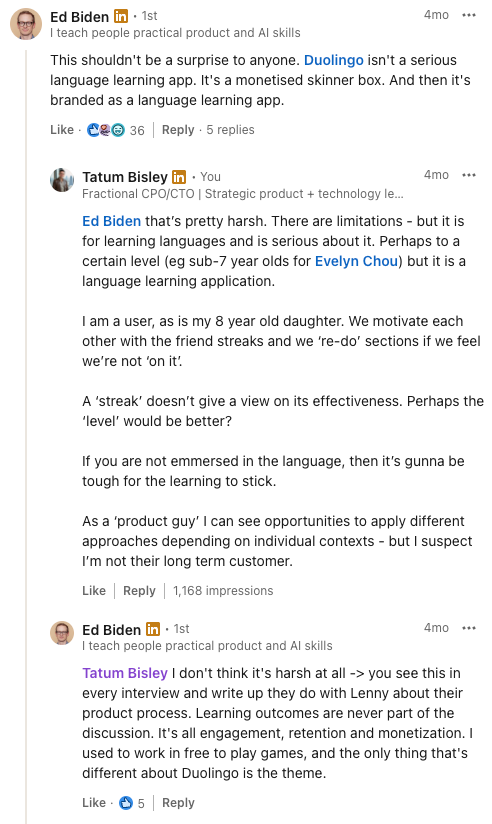
A LinkedIn product manager recently sparked controversy (well, with me) by claiming that despite maintaining a 1000-day Duolingo streak, she couldn’t hold a basic conversation with a 7-year-old. Her conclusion? Duolingo isn’t a real language learning app. Further more, another PM commented that – it’s just a “Skinner Box” designed to manipulate users into compulsive behaviour without delivering genuine educational value.
After fifteen years implementing digital learning solutions – from mobile learning platforms at Fuse Universal serving hundreds of thousands of users to AI-driven educational technologies for enterprise clients like Vodafone – I can tell you that this criticism reveals more about unrealistic user expectations than it does about Duolingo’s effectiveness.
The human brain simply cannot effectively acquire eight languages concurrently, regardless of the platform. More importantly, no app-based learning system – however sophisticated – can replicate the immersive, conversational practice necessary for fluency development. The real question isn’t whether Duolingo is a “true” language learning app, but whether we understand what language acquisition actually requires.
I’ve shared the LinkedIn posts that sparked my desire to talk about Duolingo 👇🏼

What Language Acquisition Actually Demands: The Research Reality
My comprehensive analysis of academic research on Duolingo reveals a complex effectiveness picture that most critics completely misunderstand. The Mobile-Assisted Language Learning (MALL) research field shows that while over 3,500 studies have been published since the 1990s, quality research on app-based learning effectiveness remains methodologically limited.
Critical research gaps include inadequate establishment of baseline proficiency (affecting 34% of studies), disproportionate focus on reading (20%) and grammar (12%) skills rather than comprehensive language development, and most concerning – lack of verification of actual app usage during research periods. Having faced similar challenges measuring engagement, where self-reported usage often differed significantly from actual analytics, I recognise that robust measurement requires both behavioural data and learning outcome assessment.
However, the studies that do meet methodological standards reveal something important: Duolingo can be remarkably effective for what it’s designed to do. A University of Hawaii study found that learners using solely Duolingo achieved Intermediate Low reading and Novice High listening levels – paralleling university students after four semesters, but requiring only about half the time.
The key insight? Duolingo excels at foundational skill development and habit formation, not comprehensive fluency acquisition.

A Learning Framework that works - Understanding the 70:20:10 Model
During my time implementing the 70:20:10 learning framework (at Phones 4u), we discovered a fundamental truth about effective learning that applies directly to language acquisition:
- 70% Experiential Learning: Learning through experience, practice, and real-world application
- 20% Social Learning: Learning through interaction with others, feedback, and collaborative experiences
- 10% Formal Learning: Structured lessons, systematic skill progression, and content delivery
Duolingo primarily addresses the formal learning component (10%), providing structured lessons, grammar explanations, and systematic skill progression. The platform’s gamification elements and streak mechanics represent sophisticated attempts to bridge into experiential learning through daily practice and habit formation.
But here’s what the viral LinkedIn critic missed: achieving language fluency requires the other 90% – experiential practice through real conversations and social learning through authentic interactions with native speakers. No app can force you to have dinner conversations in Spanish or join Italian conversation groups. That’s the user’s responsibility.

The Common European Framework Reality Check
The Common European Framework of Reference for Languages (CEFR) provides the most widely recognised standard for language proficiency globally. Having worked with international clients and designed learning solutions for global organisations, I understand how CEFR levels translate to real-world capability:
- A1-A2 (Beginner-Elementary): Basic vocabulary, simple phrases, survival communication
- B1-B2 (Intermediate): Conversational competence, complex topics, workplace communication
- C1-C2 (Advanced-Proficient): Near-native fluency, sophisticated expression, professional competence
Research indicates that most Duolingo users achieve proficiency primarily in receptive skills (reading and listening) rather than productive skills (speaking and writing) at A2-B1 levels. This partial development reflects a fundamental challenge in app-based learning: the difficulty of developing spontaneous communication skills through artificial app-based interactions.
But this isn’t a bug—it’s a feature. Duolingo provides the foundational vocabulary and grammar structure necessary for real-world practice. Expecting it to also provide fluency without additional immersion is like expecting a gym membership to make you fit without actually exercising.

The "Skinner Box" Criticism, is it Motivation or Manipulation?
The “Skinner Box” criticism suggests that Duolingo manipulates users through variable reward schedules without delivering educational value. Having developed engagement optimisation strategies across multiple products, I recognise the sophistication required to balance motivation with authentic value creation.
Duolingo’s gamification approach includes:
- Streak mechanics that encourage consistent daily practice
- XP systems that provide immediate feedback and achievement recognition
- League competitions that add social motivation
- Achievement badges that mark learning milestones
Critics call this manipulation, but behavioural psychology research supports these mechanisms for habit formation. The key distinction lies in whether these motivational systems serve educational outcomes or exploit users for engagement metrics alone.
Recent research on Duolingo’s AI integration found significant improvements in learners’ willingness to communicate and engagement, with statistically significant effect sizes in language attitudes and communicative confidence. This suggests that Duolingo’s engagement mechanisms genuinely support learning psychology rather than merely exploiting it.
Duolingo is attempting to address experiential learning gap - and I can see some people resent the addition cost required to address it.

Recognising the limitations of app-based learning, Duolingo has invested significantly in bridging the experiential learning gap. The introduction of AI-powered conversation features in Duolingo Max represents a sophisticated attempt to provide speaking practice within the app environment.
These AI conversations allow learners to practice spontaneous dialogue with virtual characters, receiving real-time feedback on pronunciation and conversational flow. While this doesn’t replace human interaction, it provides a bridge between formal lessons and real-world practice – addressing the exact limitation that app-based learning traditionally faces.
However, this enhanced functionality comes at a premium price point, highlighting an important reality: comprehensive language learning requires greater investment – whether in time, money, or both.
How to Actually Succeed with Duolingo
Based on learning science research and practical implementation experience, here’s how to effectively integrate Duolingo into a comprehensive language learning strategy:
Foundation Building (Duolingo’s Strength)
- Daily consistency: 15-20 minutes focused practice
- Single language focus: Resist the temptation to study multiple languages simultaneously
- Skill completion: Achieve gold crowns before advancing to maintain foundation strength
Experiential Integration (The Missing 70%)
- Media consumption: Watch shows, read news, listen to podcasts in target language
- Real-world application: Order food, ask directions, conduct business in target language
- Travel or immersion: Seek opportunities for sustained target language exposure
Social Learning (The Critical 20%)
- Conversation partners: Use platforms like HelloTalk or Tandem for native speaker interaction
- Local communities: Join language exchange groups or cultural organizations
- Professional contexts: Seek work opportunities requiring target language use
My daughter always has the lyrics showing on Apple Music when we're in the car. The lyrics show the native language (Spanish in our case), and the english translations. Just make sure you download the language package for the language you want to see.
Why Duolingo Succeeds (Because of Scale) Where Others Fail
Duolingo’s effectiveness stems from scale advantages that create genuine educational value. With insights from over 500 million learners, the platform can optimise content difficulty, personalise learning paths, and identify effective pedagogical approaches at unprecedented scale.
This data advantage enables:
- Adaptive difficulty adjustment based on individual learning patterns
- Optimal spaced repetition timing derived from millions of learning interactions
- Content optimisation identifying which explanations and exercises prove most effective
Small-scale language learning apps simply cannot match this level of sophistication, explaining why Duolingo captures 60% of language learning app usage despite numerous competitors.
In Short... Understanding What You're Actually Using
Duolingo is not a complete language learning solution – and it never claimed to be. It’s a foundational skill-building platform that uses sophisticated engagement mechanisms to establish consistent learning habits. The viral criticism reveals a fundamental misunderstanding of how language acquisition works and what role different tools should play in comprehensive learning strategies.
The LinkedIn PM’s experience – 1000 days across eight languages without conversational ability – demonstrates the predictable result of misaligned expectations and poor learning strategy, not platform failure. Had she focused on a single language while integrating Duolingo with conversation practice and real-world application, her outcome would likely have been dramatically different.
For product managers, Duolingo’s approach offers valuable lessons about user motivation, habit formation, and the balance between engagement optimisation and authentic value delivery. The platform succeeds because it clearly understands its role in the learning ecosystem and executes that role exceptionally well.
The real question isn’t whether Duolingo is a “true” language learning app – it’s whether users understand how to integrate it effectively into comprehensive language acquisition strategies. Used correctly, Duolingo provides the foundation upon which fluency can be built. Used incorrectly, it becomes an engaging but ultimately limited exercise in digital habit formation.
The choice, as always, belongs to the learner.
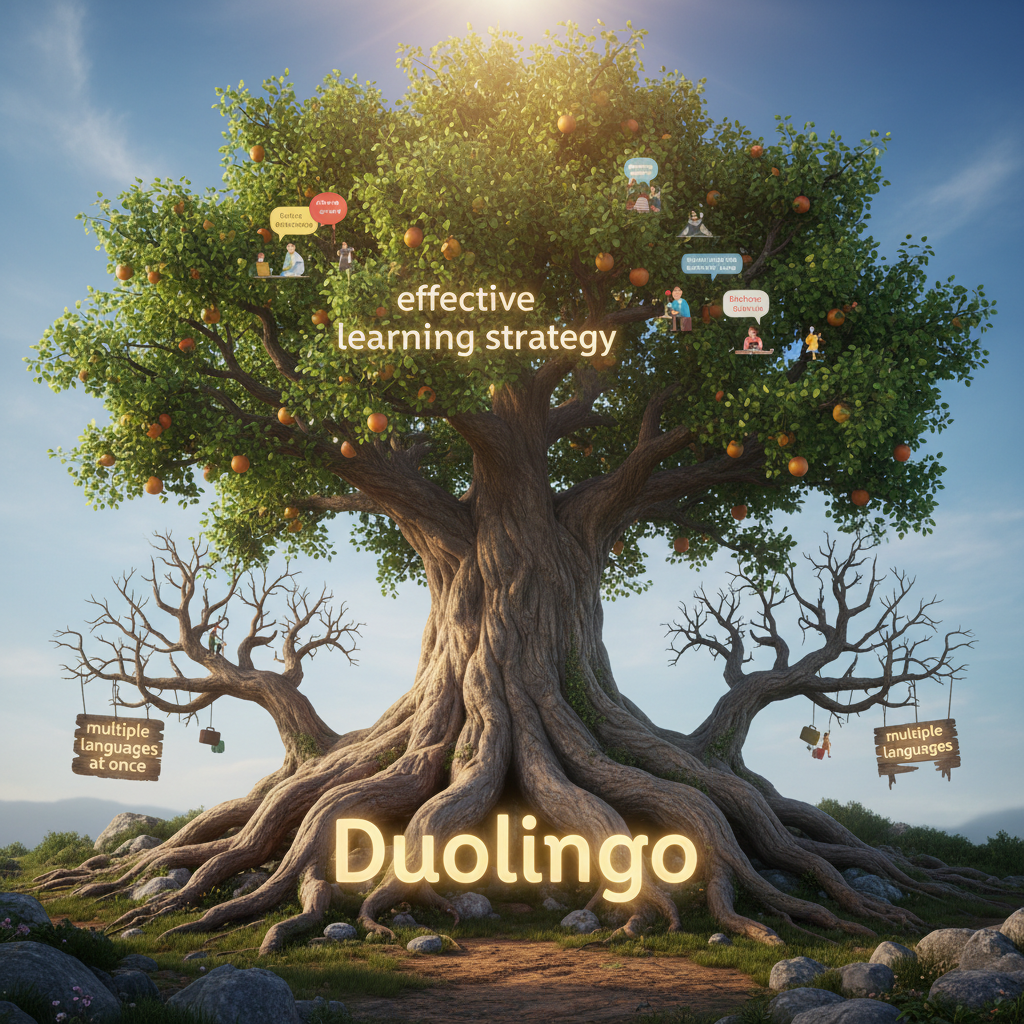
The images in this post are the raw images generated by Gemini Nano Banana based on the blog content. If you haven’t done so already, go to https://aistudio.google.com/ build your own!